
What Is a No-Rise Certification and When Do You Need One in Atlanta?
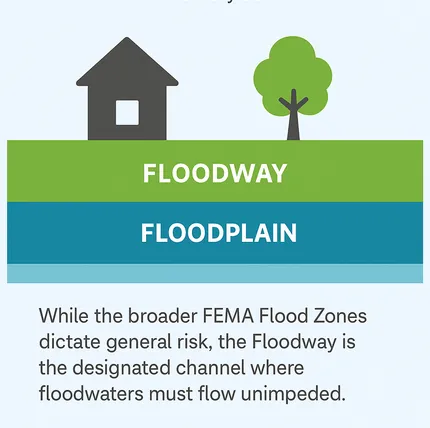
For property owners developing land adjacent to or within a designated floodway, the No-Rise Certificate is a crucial and often mandatory document. While the broader FEMA Flood Zones dictate general risk, the Floodway is the designated channel where floodwaters must flow unimpeded. Any construction, filling, or obstruction in this area is strictly regulated in Metro Atlanta and across Georgia to prevent increasing flood heights elsewhere.
The No-Rise Certificate is the formal engineering proof that a proposed development, when built, will not result in any increase to the Base Flood Elevation (BFE). Without this certification, local jurisdictions in areas like Fulton County or the City of Atlanta will deny the necessary building permits.
At Radovic Permits, our specialized permit consultant Metro Atlanta services handle the complex hydraulic modeling required for this certification, transforming restricted land into developable property.
Floodway vs. Floodplain

Understanding the distinction between these two terms is the first step in knowing whether a No-Rise Certificate is required.
Defining the Floodway
The Floodway is the central, most hazardous portion of the Special Flood Hazard Area (SFHA), designated on FEMA's Flood Insurance Rate Maps (FIRMs).
Function: It is defined as the channel of a river or other watercourse and the adjacent land areas that must be reserved to discharge the 100-year flood (or Base Flood) without cumulatively increasing the BFE more than a designated height (often 0.00 feet, thus "No-Rise").
The Regulatory Line: Floodway boundaries are precisely defined on FIRMs, usually appearing as a distinct line within the broader Zone AE.
Zero Tolerance: Local floodplain ordinances in Georgia are designed to prevent any measurable increase in the BFE within the floodway because even a small obstruction can divert floodwaters and increase flood risk for adjacent properties.
When the Certification is Mandated
A No-Rise Certification is required any time a project involves placing an obstruction or filling within the mapped floodway.
New Construction or Additions: Building a structure, garage, or substantial addition that encroaches into the floodway.
Filling or Grading: Bringing in soil, gravel, or other fill material for the purpose of elevating the site within the floodway boundary.
Utility Infrastructure: Installing bridges, large culverts, pipelines, or other utility structures that cross or occupy the floodway.
Note: If your property is only in the surrounding Flood Fringe (the area outside the floodway but still in the SFHA), you generally do not need a No-Rise Certificate, but you must still elevate the lowest floor above the BFE.
The Engineering and Submission Process
Obtaining a No-Rise Certificate is an intricate process that requires the specific expertise of a licensed engineer familiar with hydraulic modeling.
Required Engineering Analysis
The certification is based on a detailed hydraulic study to prove the project's compliance with local floodplain management standards.
Hydraulic Modeling Software: The engineering must be performed using approved software, such as the U.S. Army Corps of Engineers' HEC-RAS (Hydrologic Engineering Center River Analysis System).
Two-Model Comparison: The engineer runs two primary models:
Existing Conditions: The model simulates the Base Flood flow rate through the floodway as it exists currently.
Proposed Conditions: The model simulates the Base Flood flow rate with the proposed construction or fill in place.
The Conclusion: The results must demonstrate that the water surface elevation (the BFE) in the Proposed Conditions model does not rise by more than 0.00 feet at any point compared to the Existing Conditions model.
Submission and Review
The No-Rise Certification is not a standalone document; it is a required component of the building permit application for that property.
Local Floodplain Administrator: The complete HEC-RAS analysis, certified by a Georgia-licensed Professional Engineer, must be submitted to the local city or county floodplain administrator (often part of the Planning, Engineering, or Public Works departments).
Coordination with Permit: The Building Department will place a hold on the overall permit until the Floodplain Administrator approves the No-Rise study. This process often runs concurrently with other required reviews, such as zoning research Atlanta or general plan review.
Consequences of Non-Compliance
Attempting to build within a floodway without a No-Rise Certificate is an immediate violation that will result in a Stop-Work Order (SWO) and severe penalties.
Avoiding Costly Delays

Design for Minimization: The best way to achieve a No-Rise Certificate is to design the project to minimize the encroachment into the floodway (e.g., using pilings instead of solid foundations, reducing the footprint, or relocating structures entirely).
Mandatory Mitigation: If the initial analysis shows a rise in the BFE (a "rise" condition), the engineer must redesign the project to include compensatory mitigation—often by excavating an equivalent volume of earth in a nearby area to offset the loss of flood storage capacity created by the building or fill. This adds significant cost and site work.
By confirming the No-Rise compliance during the pre-acquisition or initial design phase, property owners prevent major financial risk and ensure a smooth, legal path to obtaining their construction permit.